
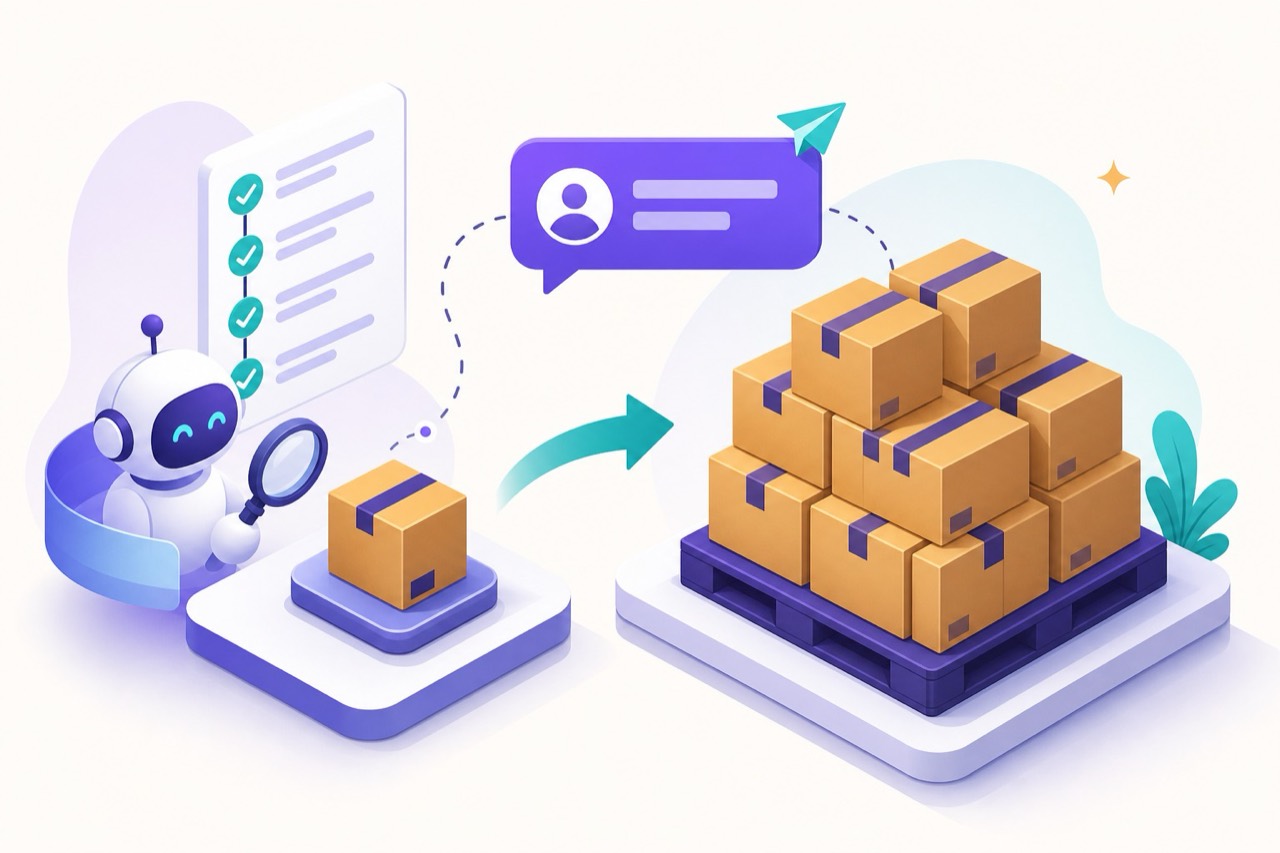
Buyers ask ChatGPT first, then come to you: what will they ask, and how should you answer first?
They arrive with verification questions. 83% of buyers visit the websites of suppliers an AI tool mentions, and 71% avoid suppliers that lack clear information (Magenta, 2025). Most already hold a shortlist, and they come to you to confirm MOQ, lead time, certifications, a price range and whether you can customize. Whoever answers clearly first moves to the next round. So the first reply should be in the buyer's language, answer the exact question asked, and end with one question that moves things forward. DeepSales handles that first reply 24/7.
How are AI-referred visitors different from ordinary visitors?
They have already done their homework.
Among North American industrial buyers, 92% used AI tools to research suppliers in the past 90 days, and 83% had shortlisted a supplier before speaking to anyone there (Kula Partners, 2025). A UK survey points the same way: 66% of B2B decision-makers use AI to research suppliers, and 85% of them have discovered a new supplier through an AI-generated answer (Magenta, 2025).
That does not mean they trust the AI blindly. Gartner found that 69% of B2B buyers turn to sales reps to validate AI-generated insights (Gartner, 2026). When one of these buyers lands on your site or messages you on WhatsApp, they are rarely browsing. They are checking. The AI said you hold CE certification: is that true? It said your minimum order is low: is that still the case?
Two honest caveats, so expectations stay realistic:
- The volume is small. On B2B websites, AI referrals make up only 1.8% of combined AI and organic search visits (Leadfeeder, 2026).
- The fit is not automatically better. In the same study, 15.8% of AI-referred visitors matched the target customer profile, against 20.4% for organic search and 19.1% for paid search (Leadfeeder, 2026).
So the real difference is not that AI visitors are worth more. It is that they arrive later in their process, ask sharper questions and compare faster. If your answer is slow or vague, the next supplier on their list is one click away.
| Aspect | Typical search visitor | Visitor who asked an AI first |
|---|---|---|
| What they did before arriving | Searched a phrase and opened a few sites | Had an AI build a shortlist and read its summary of you |
| Typical first question (illustrative) | "Do you make this?" "Do you have a catalog?" | "What's the MOQ on this model?" "Is it UL listed?" |
| What they want | To learn first, then decide whether to talk | To verify a few facts and decide whether you stay on the list |
| Cost of a slow reply | They might come back next week | They message the next supplier on the list |
What are the eight questions they ask most, and what should you prepare?
The table below groups the questions buyers most often come to verify. The third column is what your website and product material should state plainly. The last column is who should answer.
| Question type | How buyers phrase it (illustrative) | What to have ready | Who answers |
|---|---|---|---|
| MOQ | "What's the minimum for this model? Can I mix colors?" | MOQ per product line, mixed-order rules, trial-order policy | AI, from your material; requests below MOQ go to a person |
| Lead time | "How soon can you ship after the order? Does peak season delay it?" | Standard lead-time range, peak-season impact, rush conditions | AI gives the standard range; firm production commitments go to a person |
| Certifications | "Do you have CE, UL or FCC? Can you share the certificate?" | Certificate list, covered models, certificate numbers or samples | AI states only certificates you hold, and says so plainly when you don't |
| Price range | "Roughly what's the price at this quantity?" | Quote rules: quantity tiers, Incoterms, validity period | AI quotes within your rules; special prices, large orders and exceptions go to a person |
| Customization | "Do you do OEM? Can you print our logo?" | What can be customized, custom MOQ, sampling time | AI collects the requirement; engineering or sales judges feasibility |
| Samples | "Can you send a sample? Is the fee credited against the order?" | Sample policy, cost, shipping method | AI explains the policy; waivers and exceptions go to a person |
| Payment and trade terms | "Do you accept L/C? Can you quote CIF?" | Accepted payment methods, usual Incoterms | AI covers standard practice; credit terms and L/C clauses go to a person |
| After-sales and warranty | "How long is the warranty? How do replacements work?" | Warranty period, spare parts, service process | AI explains the policy; claims and complaints go to a person immediately |
Treat the table as a website audit. Any row your site cannot answer forces buyers, and the AI tools summarizing you, to look elsewhere or skip you. Remember that 71% of buyers avoid suppliers without clear information (Magenta, 2025). Unclear pages hand your place on the shortlist to someone else.
How should you write the first reply?
Here is a common pattern (illustrative). A buyer in Germany asks, in German, during their afternoon: "Is this motor CE certified? What's the minimum order?" The next day they receive an English email:
"Thank you for your inquiry! We are a professional motor manufacturer with many years of export experience... Please find our company profile and catalog attached."
Two questions asked, none answered. The reply came a day late and in a different language. A reply like that sends the buyer straight back to the AI's shortlist.
A good first reply does five things:
- Uses the buyer's language. Asked in German, answer in German.
- Answers the exact question first. Certification and MOQ go at the top. The company profile goes later, if at all.
- Gives something verifiable. Which models the certificate covers and where the spec page is, so the buyer can check for themselves.
- Asks one question that moves things forward. Quantity, destination port or timing. One question, not five.
- States the next step. Who follows up for a formal quote or sample, and when.
The same exchange, rewritten (illustrative, originally in German):
"Hello! Yes, this motor is CE certified, and the certificate covers every model in the series. You can see the details on the product page, along with the standard MOQ, and you can mix two power ratings in one order. Could you share your rough quantity and destination port? I'll give you a price range for that volume."
No pleasantries, yet both questions are answered in the first lines and the conversation moves one step closer to a quote. A buyer who arrives from an AI tool with a question in hand does not want to be met with a brochure.
What if they ask about price?
Price is the question AI-referred buyers ask most often, and the one most often deflected with "please leave your email and we will send a quotation." They have already seen rough price levels for several suppliers. They came to you for a number.
The fix is to set quote rules in advance: which products can get a range straight away, which quantity tiers apply, which Incoterm, and how long the quote is valid. Inside the rules, answer directly. Outside them, such as special prices, volume discounts or non-standard builds, hand over to a salesperson. Negotiation and the final decision always stay with people.
If buyers go quiet after receiving a price, that is a separate problem, covered in buyers who ask for a price and then go silent.
What about buyers who show up while you sleep?
Buyers who research with AI tend to compare suppliers during their own working day, which is often your night. In 16 years of B2B export marketing, Singoo Cloud has watched inquiries die at the door again and again: night-time messages answered the next day, buyers writing in less common languages with no one to reply.
The research on response speed is old but clear. An analysis of 1.25 million leads found that firms contacting a lead within an hour were nearly seven times as likely to qualify it as firms that waited one more hour (HBR, 2011). The study measured qualification, not orders, but the direction is plain: the later the reply, the harder the conversation.
How to catch these inquiries instantly and then judge intent is covered in night-time inquiries going cold.
What should your website say so both AI and buyers understand you?
A buyer's first impression of you increasingly comes from a paragraph an AI wrote about you. What the AI can say depends on what your site states. A few things you can do now:
- Put facts on the page, not in PDFs. MOQ, lead-time ranges, certifications, export markets and factory details, written as plain text.
- Write common questions as Q&A. The heading is the buyer's question; the first sentence is the answer.
- Keep details consistent everywhere. If your website, social profiles and B2B marketplace listings disagree on MOQ or certifications, both the AI and the buyer get confused.
- Show an updated date. An outdated price range or lead time does more harm than none.
These steps make your pages easier to read and summarize. Nobody can make an AI recommend you. Whether exporters should invest in GEO at all, and which AI to write for first, is covered in should exporters invest in GEO.
Is this inquiry worth handing to a salesperson right now?
AI-referred buyers tend to ask specific questions. That is a good sign, but it does not prove they are real buyers. Check five signals: a verifiable identity, a specific requirement, a buying timeline and target market, willingness to answer follow-up questions, and genuine contact details. The more signals present, the faster a salesperson should take over. How to score them, and why low scores should not be deleted, is in real buyer or time-waster: a scoring sheet.
What does DeepSales do here?
DeepSales is Singoo Cloud's done-for-you AI Sales Agent for exporters. In the "buyer asks an AI first, then contacts you" scenario, it does the following:
| Step | What DeepSales does |
|---|---|
| Catch | Answers 24/7 on six channels, including website chat, WhatsApp, Messenger, Instagram and LINE, replying in the buyer's language across a dozen-plus major languages |
| Answer specifics | Answers MOQ, lead time, certification, sample and payment questions from your own product material, and does not invent what is not there |
| Quote | Quotes within the rules you set; special prices, large orders and exceptions go to a person |
| Qualify | Asks naturally about quantity, destination and timing, and sorts inquiries into A, B and C |
| Hand off | A-grade leads enter a handoff queue and are routed by region, language and product line with a briefing card; replies are translated for the rep, and the AI goes silent once a person takes over |
| Record | Every lead lands in the built-in Singoo Cloud CRM, tagged with its source channel and ad |
| No reply | Short-term reactivation runs for at most three days with at most three follow-ups; after that, tag-based long-term nurturing takes over |
The boundaries, stated plainly: DeepSales does not make AI tools recommend you, and it does not build prospect lists or send cold email. What your website says and how your quote rules work are your decisions; we work with your team to turn them into material the agent can use. Negotiation and final decisions always stay with people. To see how an inquiry carrying a specific question gets answered, book a demo.