
How do you follow up hundreds of trade show leads in multiple languages?
Work in three stages. Within 48 hours, grade every contact A, B or C based on what you actually discussed at the stand, and send a first message that names the products you talked about, includes a photo and asks one specific question. Within two weeks, move every A-grade buyer to a quote or a sample. Put everyone else into long-term nurturing, tagged by product, market and buying cycle, and give each touch something new instead of a mass thank-you email. Write in the buyer's language, on the channel they gave you. An AI Sales Agent such as DeepSales can pick up the multilingual replies that come back.
Why do trade show leads go cold so fast?
Because the buyer met a lot of suppliers that week. Back at the office they have a stack of business cards and a camera roll of booth photos, and they remember only a few suppliers: the ones who wrote first, wrote specifically and remembered what was asked.
Shows are getting busier, not quieter. The autumn session of the Canton Fair, China's largest export fair, drew 352,000 overseas buyers in November 2026, up 12.2% (as reported by Sina Finance, 2026). More buyers in the halls also means more competing suppliers in each buyer's inbox afterwards.
Speed has been measured for online leads. In a study published in 2011, Harvard Business Review audited 2,241 US companies: the average first response took 42 hours, and 23% never responded at all. A separate analysis of 1.25 million leads found that firms contacting a lead within an hour were nearly seven times as likely to qualify it as firms that waited one more hour, and more than 60 times as likely as firms that waited 24 hours or longer (HBR, 2011). Those were web leads, not booth contacts, so don't apply the multipliers literally. The direction is the same: the buyer's memory fades while your competitors follow up.
The bottleneck is usually on the exhibitor's side. After a show, the team is jet-lagged, catching up on a week of normal work and looking after existing customers. Cards stay in bags, badge scans sit in individual phones, and a week disappears. At Singoo Cloud we have worked in B2B export marketing for 16 years, and we keep seeing inquiries die at the door: night-time messages answered the next day, and messages in smaller languages that nobody picks up. Show leads die the same way.
Is it true that 80% of trade show leads are never followed up?
Probably not, and nobody can point to the original study. The figure circulates widely, but people who tried to trace it concluded that it is misattributed (Tendro). The closest original source appears to be a 2010 exhibitor survey by Lynch Exhibits and In4med. As summarised second-hand, it found that fewer than 70% of exhibitors had a formal follow-up plan, 47% tracked their leads and only 28% measured how those leads converted (as cited by American Image Displays).
That is less dramatic than 80%, but the lesson holds: plenty of exhibitors intend to follow up, and far fewer have a process for it. The rest of this article is that process.
What should you do the night the show ends?
Turn the cards and badge scans into one list while the conversations are still fresh. For each person, add three things: which products you discussed, what they said they need in their own words, and which language they prefer. Then grade them:
| Grade | Typical signals (illustrative) | First message within 48 hours |
|---|---|---|
| A | Asked about a specific model, quantity or target price; mentioned a timeline or destination market; importer, distributor or end buyer | Include a quote outline or sample plan; propose a video call or factory visit |
| B | Interested but vague, or buying in six months or more | Send the materials and photos you discussed; ask one specific question |
| C | Collecting catalogues, competitors, service vendors, students | A short thank-you with a catalogue link; move to nurturing, don't delete |
The grading doesn't need to be precise. Its job is to decide who gets your attention first and how much. For a fuller scoring sheet, see how to tell a real buyer from a time-waster.
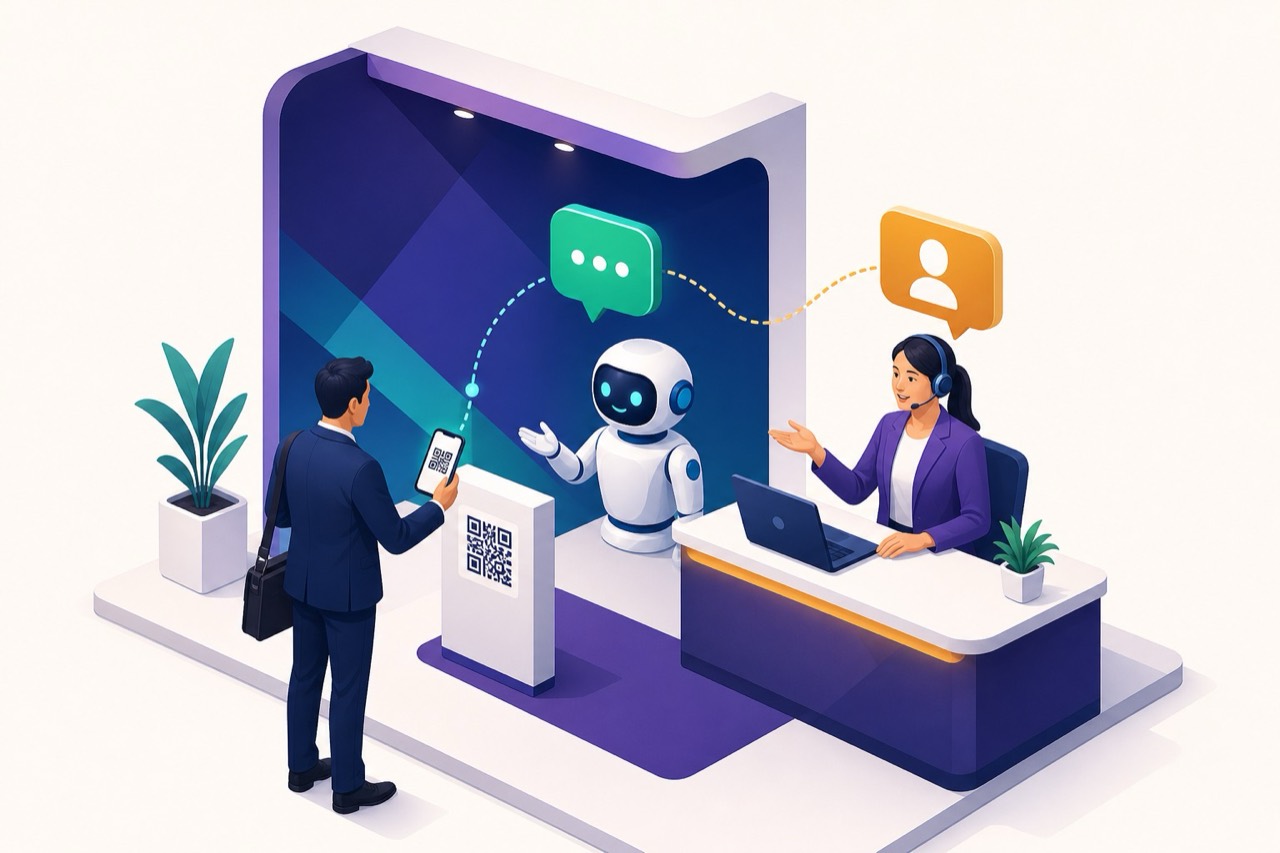
Two habits at the stand make all of this easier. Display a QR code that opens a WhatsApp chat with you, so visitors send the first message themselves. And when you swap cards, photograph the back where you scribbled their requirements. The first keeps every conversation in one place from day one. The second means you aren't relying on memory the next morning.
What happens between 48 hours and 90 days?
| When | Action | Channel | What to say |
|---|---|---|---|
| Show day and that night | Clean up, grade, add notes | Spreadsheet or CRM | Record the buyer's need in their words, not just the company name |
| Within 48 hours | First follow-up | The channel they gave you: WhatsApp if they scanned your code, email if you only have a card | Your stand number and a detail from the conversation; a photo or short video of the product you discussed; one specific question (quantity, target price, lead time); in their language |
| Days 3 to 7 | Second touch for A and B | Same channel | Fill the gaps they care about: spec sheet, certifications, sample policy, lead time |
| Within two weeks | Move A-grade buyers to a quote or sample | Video call, factory video, formal quote | State Incoterms, MOQ and validity; agree the date of the next conversation |
| Weeks 3 to 4 | One more attempt for non-responders, from a new angle | Same channel | Not "did you get my email?" but a new reason: a new model, a relevant application, a lead-time change |
| Days 30 to 90 | Long-term nurturing | By tag | Tag by product line, market and buying cycle; one useful touch every two to four weeks |
| After 90 days | Lower the frequency and save them for the next show | Same channel | A month before the next show, invite them to your stand and refer back to last time's conversation |
The day counts are a suggested rhythm, not a rule. In industries with long buying cycles, such as machinery or construction equipment, nurturing for six months or more is normal.
How do you write a first message that doesn't read like a mass email?
The trouble with a mass thank-you is that the buyer gets a pile of them that week, and they all look alike. What makes yours stand out is a detail only the two of you know. Four parts are enough:
- Who you are: company name and stand number. "We spoke at Hall X, stand Y."
- What you remember: the model they asked about, the certification they need, the market they sell into.
- What you are sending: one or two things you discussed, such as a product photo, a short video or a spec sheet. Not the whole catalogue.
- One specific question: "Roughly what quantity are you considering for this model?" is far easier to answer than "Let me know if you have any questions."
For A-grade buyers, add a quote outline or offer a video call to review samples. For B-grade buyers, the goal is to be remembered and to get one answer. For C-grade contacts, a short thank-you with a catalogue link is enough.
How do you follow up across dozens of countries and languages?
Let the buyer's language lead. A buyer who spoke English at your stand may still prefer to read a long message in Arabic, Spanish, Portuguese or Russian, and often replies faster in it. A few practical rules:
- Write the first message in English plus the buyer's language, then continue in whichever language they reply in.
- Keep one bilingual glossary for product names, model numbers, units and trade terms, and never let translation change them.
- Machine translation is fine for prose, but have a person check every number, unit and specification.
- Schedule messages for the buyer's working hours, not 3 a.m. in their time zone.
The hard part isn't the first message. It's the replies. The two weeks after a show tend to bring the most responses, arriving from a dozen countries, at all hours and in different languages, and a small team can't answer each one within minutes. For catching night-time replies, see how to capture after-hours inquiries and score intent.
How do you keep following up without becoming spam?
Separate two cases. A buyer who chatted and then went quiet has just gone silent: pick up where the conversation stopped, add something new each time, and cap one round at three follow-ups over about three days. A buyer who never replied after the show has dropped off: move them into long-term nurturing, stretch the interval to weeks, and give every message a fresh reason.
Good reasons include a new model, a certification change in their market, a change in lead time or capacity, or an answer to a question similar buyers often ask. "Just checking you received my email" is not a reason. For cadence and wording, see how to follow up without becoming spam.
Respect the channel rules. A follow-up email after swapping business cards is normal business practice. Proactively sending WhatsApp template messages, however, requires the contact's opt-in under WhatsApp Business rules. A QR code at your stand that the buyer scans to message you first is the most natural opt-in there is. The EU and some other markets add data-protection requirements on top, so if in doubt, check the local rules.
Should you call trade show leads?
Yes, for contacts you have already met who left a phone number. Take an A-grade buyer who went deep at your stand but hasn't answered messages for two weeks: one call often does more, and annoys less, than a fifth message.
Be careful with calling an entire imported list. Check the target country's rules on business calls first, include only people who clearly exchanged contact details with you, and call within their business hours. For more, see how to use AI outbound calls without sounding like a robocaller.
Was the trade show worth what it cost?
Shows are among the most expensive lead sources there are. In Sopro's compilation of B2B benchmarks, trade shows and in-person events average about $840 per lead, with a typical range from $180 to more than $1,500 (Sopro, 2025). The stand, the build, the flights and the samples are already paid for. Follow-up costs almost nothing, yet it decides how much of that spend comes back.
For a channel-by-channel comparison, see how much a B2B export lead costs by channel.
What does DeepSales do in post-show follow-up?
DeepSales is Singoo Cloud's done-for-you AI Sales Agent for exporters. It doesn't find prospects or send cold emails. Its job is to catch the conversations that come back after the show, qualify them and keep them moving.
| Stage | What DeepSales does | Who owns it |
|---|---|---|
| Buyer scans your code or replies | Picks up on WhatsApp, website chat, Messenger, Instagram, LINE and other channels (six in total), 24/7, replying in the buyer's language across a dozen-plus major languages | AI |
| Product questions | Answers from your own product materials: specifications, certifications, MOQ, sample policy | AI |
| Qualification | Asks about quantity, destination market and timeline in the conversation, tags the buyer A, B or C, and logs the lead with its source in the built-in Singoo Cloud CRM | AI; reps can override |
| A-grade buyers | Hands off to the right rep by region, language or product line, with a briefing card covering who the buyer is, what they need, how warm they are and a suggested opener; the AI goes silent once the rep takes over, and translation is available at handoff | Your rep |
| Buyers who just went quiet | Short-term reactivation: one round lasts up to three days, with at most three follow-ups | AI |
| Buyers who dropped off | Long-term nurturing on a tag-based cadence | AI |
| Buyers who left a phone number | AI outbound calls to existing leads, with the recording, transcript and call summary written back to the customer record (Advanced plan and above) | AI; you own the list and compliance |
| Quotes and negotiation | Drafts quotes from your pricing rules (Advanced plan and above; on the entry plan it gathers requirements and hands pricing to a person); negotiation, exceptions and final decisions always stay with people | Your rep |
Relationships built at a show are still maintained by people. DeepSales makes sure the first reply, the follow-up questions and the follow-through don't stop just because the team is stretched. To see how post-show conversations are picked up and graded, book a demo.